
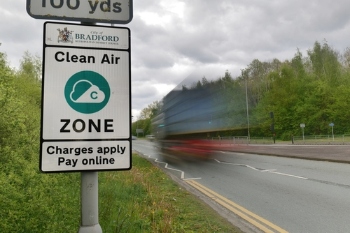
Bradford’s Clean Air Zone (CAZ) has been one of the most significant public‑health interventions the district has ever implemented. Introduced under a legal direction from the UK Government, its purpose is simple: reduce nitrogen dioxide (NO₂) pollution to legal levels as quickly as possible.
With Reform UK now leading Bradford Council and expressing a desire to remove the CAZ, it’s important to look carefully at what the CAZ has achieved, what the law requires, and what risks the district faces if the scheme is dismantled prematurely.
This article sets out the evidence so residents can understand the implications.
What the CAZ Has Achieved So Far
Significant reductions in harmful pollution
Independent monitoring shows that since the CAZ was introduced:
- NO₂ levels have fallen across the district, including at long‑standing hotspots such as Manningham Lane, Shipley Airedale Road, and Mayo Avenue.
- Bradford Council’s own data shows compliance at most monitoring sites, with only a small number still above legal limits.
- Bradford has seen one of the fastest improvements in air quality of any UK local authority implementing a CAZ.
These improvements matter. Nitrogen dioxide and particulate pollution are linked to:
- childhood asthma
- heart disease
- strokes
- low birth weight
- premature death
Public Health England estimates that air pollution contributes to 1 in 20 deaths in Bradford.
Cleaner vehicles and a modernised fleet
The CAZ has accelerated the shift to cleaner vans, taxis, buses and HGVs:
- Over 3,000 taxis have upgraded to cleaner vehicles.
- Thousands of vans and lorries have been replaced or retrofitted.
- Bradford now has one of the cleanest taxi fleets in the UK.
- Bus operators have invested heavily in Euro VI and electric vehicles.
These upgrades were supported by over £30 million in grants — funding that would not have been available without the CAZ.
Some are arguing that the CAZ harms businesses but removing the CAZ now risks undermining businesses that upgraded in good faith and creating an uneven playing field, harming those that have invested in cleaner vehicles.
Traffic and congestion impacts
Despite claims that the CAZ has increased congestion, the data shows:
- No significant increase in traffic volumes attributable to the CAZ.
- Some corridors have seen reduced congestion due to cleaner, more modern vehicles and better fleet management.
- Journey times on key routes have remained stable.
- Lots of people complain on social media about more polluting vehicles changing their routes – and there will be some re-routing, but there will also be a reduction in journeys by the heaviest polluters and a switching of vehicles to cleaner ones.
The CAZ is not a congestion charge, it targets vehicle emissions, not vehicle numbers.
The Legal Reality: Bradford Cannot Simply Remove the CAZ
Bradford is still under a Ministerial Direction from central government. This legally requires:
- A Class C CAZ
- Demonstrated compliance with legal NO₂ limits
- A period of sustained compliance (up to two years)
- Government sign‑off through the “Four State” process
Bradford is not yet in full compliance at all monitoring sites.
Until the Government lifts the Direction, the CAZ cannot legally be removed, regardless of which party controls the council.
This is about meeting statutory air‑quality obligations that apply to every local authority in the UK.
The CAZ Doesn’t Go Far Enough
While the CAZ has delivered real improvements, it is not a complete solution to Bradford’s air‑quality problems.
A. Children are still exposed to harmful pollution
Even with NO₂ falling:
- Particulate matter (PM₂.₅ and PM₁₀) remains a major health threat.
- These particles come from tyre wear, brake dust, road abrasion, and sheer traffic volume — not just exhaust pipes.
- Children walking to school along busy roads are still breathing levels of pollution that harm lung development.
The CAZ tackles one pollutant from one source. It does not address the full picture which includes stress levels, noise, sedentary lifestyles, car dependency, fear of walking and cycling in busy areas etc.
B. Traffic volumes remain far too high
Bradford has:
- some of the highest traffic volumes per capita in the region
- chronic congestion on key corridors
- thousands of short car trips that could be walked, wheeled, or cycled
High traffic volumes cause:
- particulate pollution
- noise pollution
- road danger
- community severance
- reduced physical activity
- poorer mental health
Even if every vehicle were electric tomorrow, several health harms of excessive traffic would remain.
C. Reducing traffic is a separate debate — but it shouldn’t undermine what the CAZ has achieved
It’s important to be clear:
- The CAZ is not a traffic‑reduction scheme.
- It was never designed to solve every pollution problem.
- It is a minimum legal requirement, not an ambitious climate or transport policy.
But that does not diminish its achievements.
The CAZ has delivered:
- cleaner fleets
- lower NO₂
- millions in grants
- rapid compliance improvements
It is a step, not the end point.
Removing it would take Bradford backwards, not forwards.
What Risks Would Bradford Face if the CAZ Is Removed?
A. Rebound in pollution levels
Without the CAZ:
- Older, more polluting vehicles may return to the district.
- NO₂ levels could rise again at the remaining hotspots.
- Bradford could fall back out of compliance, triggering further government intervention.
B. Loss of public‑health gains
Cleaner air has already reduced exposure for:
- schoolchildren
- people with asthma
- older residents
- pregnant women
Removing the CAZ risks reversing these gains.
C. Financial and legal consequences
If pollution rises again:
- The Government could re‑impose a CAZ, potentially a stricter Class D (including private cars).
- Bradford could lose access to future clean‑air funding.
- Businesses that upgraded could feel penalised compared to those who waited.
D. Damage to Bradford’s reputation
Bradford has been recognised nationally for:
- rapid air‑quality improvement
- strong business support
- effective implementation
Removing the CAZ early could undermine that progress and credibility.
Conclusion
Bradford’s CAZ has delivered clear, measurable improvements in air quality, public health, and vehicle standards. But it is only a first step. Children and communities are still exposed to harmful particulate pollution, and traffic volumes remain far too high for a healthy city.
These wider challenges deserve their own debate — but they should not be used to dismiss or undo the progress already made.
Removing the CAZ prematurely would put Bradford’s health, legal compliance, and long‑term credibility at risk.